AI efficiency gains
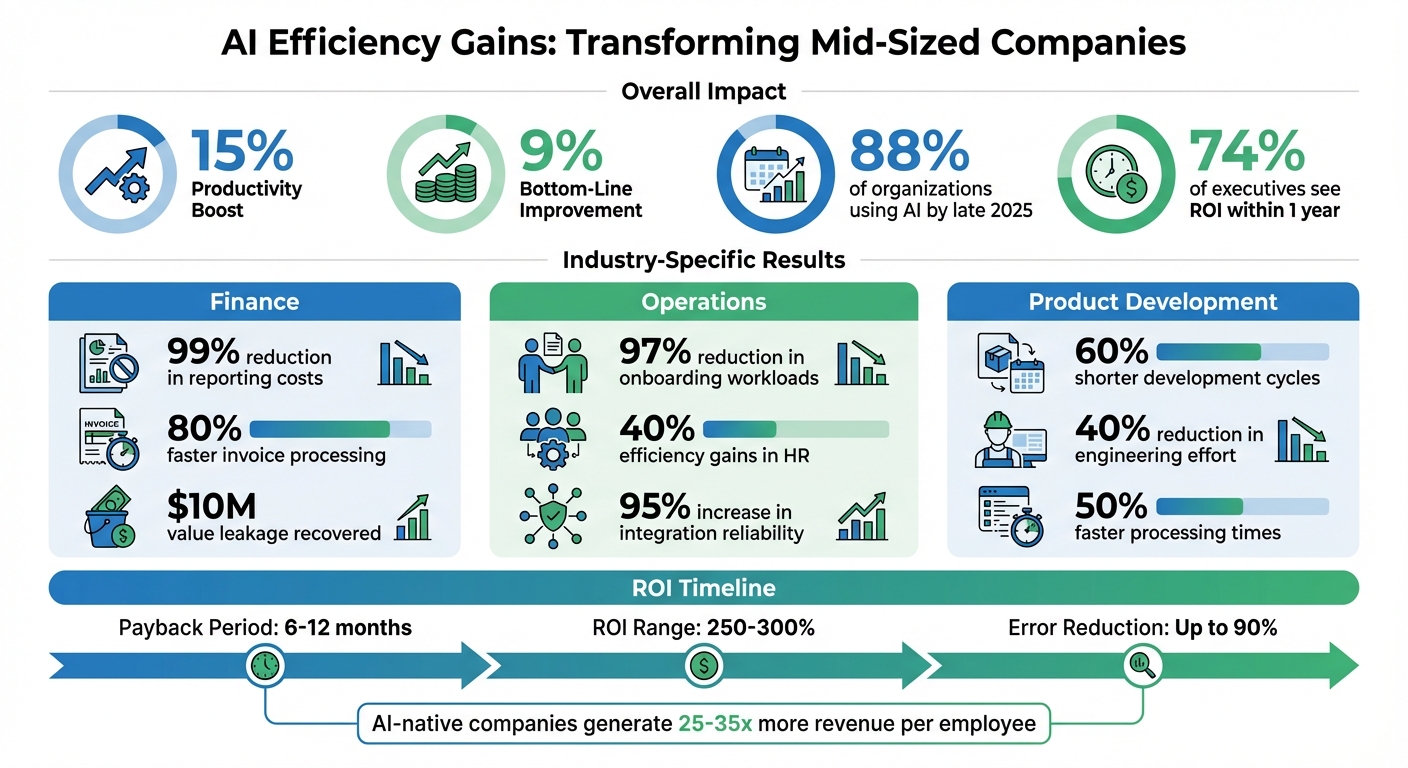
Mid-sized companies are transforming operations with AI agents that manage complex workflows like invoicing and onboarding. These systems deliver 15% productivity boosts and 9% bottom-line improvements through faster task execution and reduced errors. For example, a shipbuilder cut engineering effort by 40%, and a payroll provider sped up processing by 50%. By late 2025, 88% of organizations used AI in at least one function, with 74% of executives seeing ROI within a year.
Key takeaways:
- AI eliminates delays by enabling parallel task execution.
- Successful AI adoption involves redesigning workflows, not just automating existing processes.
- Examples include finance (cutting reporting costs by 99%), operations (reducing onboarding workloads by 97%), and product development (shortening cycles by 60%).
AI agents integrate with tools like Salesforce and QuickBooks, offering quick deployment and measurable results. Companies that rethink processes achieve faster outcomes and higher ROI, often within 6–12 months.
AI Efficiency Gains: Key Statistics and ROI Metrics for Mid-Sized Companies
How AI Agents Automate Workflows
AI's Role in Workflow Automation
AI agents go beyond traditional automation by offering flexibility and intelligence. Instead of relying on rigid, rule-based systems, these agents can observe business conditions, grasp context, plan multi-step actions, and execute tasks independently. This allows them to handle unstructured data, like analyzing customer sentiment in emails or extracting details from inconsistent invoice formats, all while learning from previous experiences.
The benefits for businesses are striking. Companies using AI-driven automation have reported productivity boosts of 25%–40%, reductions in manual errors by as much as 90%, and returns on investment ranging between 250% and 300% [8].
Take, for example, a global biotech company that, in November 2025, introduced an AI system to ensure invoice-to-contract compliance. The system automatically reviewed contracts and invoices, verifying tiered pricing and volume rebates. It uncovered a 4% contract leakage in total spending [6]. Tasks that once took hours are now automated, with the AI only flagging discrepancies when necessary.
Similarly, the Hospital for Special Surgery in New York City implemented an AI system to streamline insurance appeals. By compiling clinical data and applying payer-specific criteria, the system reduced processing time from 45 minutes to just 5 minutes per appeal. This efficiency allowed the hospital to scale from handling 100 appeals a month to over 1,100 [10].
"AI's real strength is keeping care moving in the right direction for every patient, not simply generating better analysis",
- S.V. Mahadevan, CMO and Co-Founder of Fold Health [10].
These examples highlight how AI agents bring significant operational improvements while seamlessly working alongside existing workflows.
Integration with Business Tools
Modern AI agents integrate effortlessly with existing systems using API-first architectures. Acting as a smart middleware layer, they connect tools like Salesforce, QuickBooks, Excel, and Slack. This approach allows businesses to enhance their current technology stack without the expense or disruption of replacing entire systems.
A common method these agents employ is leveraging a "Universal Semantic Layer" or "Data Fabric." This enables them to access and coordinate data across various sources, from modern cloud applications to older, on-premise databases. For mid-sized companies, this type of integration minimizes disruption while maximizing efficiency and delivering quick returns.
In 2025, a global logistics company used AI agents to automate its request-for-proposal (RFP) response process. By connecting with existing document repositories and CRM systems, the agents improved sales operations efficiency by 30%–50% [9]. Across different departments, AI agents simplify tasks such as invoice matching and fraud detection in finance, lead scoring and meeting scheduling in sales, and resolving customer service issues from start to finish.
"AI agents can be applied to so many use cases, the number of businesses adopting them should be 100%. I can quickly point to dollars saved",
One of the standout advantages of AI agents is their speed. Traditional system integrations often required months of custom development. In contrast, AI agents, using standard APIs and adapting to various data formats, can be deployed in just days, delivering immediate value.
Examples of Efficiency Improvements
Finance: Faster Underwriting and Payment Processing
AI has revolutionized finance by drastically speeding up processes like underwriting and payment cycles. For instance, in procure-to-pay workflows, AI-driven tools can handle invoice extraction and match purchase orders, cutting cycle times by as much as 80% [12]. These systems can independently interpret vendor contracts, monitor invoices for compliance, and pinpoint areas where value might be lost, such as missed early payment discounts.
Take the example of a Fortune 500 financial company that, in 2025, adopted a multi-agent system featuring tools like DataMinerAgent, CleanerAgent, and NarratorAgent. These agents automated quarterly financial reporting, reducing the process from 15 business days to just 35 minutes. Costs plummeted from $2,200 to $9 per report, while stakeholder satisfaction jumped from 72% to 91% [14]. The system also slashed error rates by 90%, dropping from 3.0 errors per report to just 0.3 [14]. By eliminating repetitive tasks like data entry and reconciliation, finance teams can now focus on strategic efforts like forecasting and risk analysis.
Operations teams are also reaping similar rewards by integrating AI into their workflows.
Operations: Automated Onboarding and Dashboards
AI is transforming operations by streamlining onboarding processes and enhancing real-time reporting. Tasks like resume screening, interview scheduling, and policy-related inquiries are now handled by AI agents, freeing HR teams to focus on strategic initiatives. Companies adopting AI-driven automation have reported efficiency gains of up to 40% and a reduction in manual workloads by 30–70% [14].
For example, in 2025, Convin, an HR tech company, deployed virtual agents to manage high volumes of candidate screening calls. These AI agents achieved over 90% accuracy in screening and automated interview scheduling, improving hiring efficiency by 40% [11]. Additionally, AI-enabled teams have been able to onboard new hires twice as fast as traditional methods [15]. Beyond speeding up processes, these systems create a centralized knowledge base, ensuring critical information remains accessible even when employees leave.
Another success story comes from a European energy provider operating in over 100 countries. In 2025, the company used AI and API-led tools to automate logistics partner onboarding. This reduced manual workloads by an astonishing 97% and increased integration reliability by 95%, offering real-time visibility into orders and vendor services [14]. Companies leveraging AI in high-volume departments like HR and Finance report productivity levels that are 2.4 times higher than their competitors [11].
"I believe that the storage of intelligence will be more valuable than an organization's brand clout in the very near term."
- David Shim, Fortune [15]
AI's impact isn't limited to administrative tasks; it’s also reshaping how products are developed.
Product Development: Faster Deployment Cycles
In product development, AI is helping engineering teams move faster by automating routine tasks such as cloud infrastructure setup, provisioning, and resource management [17]. By handling these time-consuming chores, AI allows engineers to focus on innovation. Additionally, enterprise search tools powered by AI centralize access to documentation and specifications, breaking down data silos and enabling teams to find the information they need more efficiently.
For example, Starter Stack AI clients have reported shipping products in just two weeks, compared to the two quarters it previously took. By automating 80% of client onboarding and reducing deal review times from six days to one, these companies are seeing massive improvements in speed and efficiency.
Another game-changer is AI's ability to handle preproduction testing through tools like synthetic testing and digital twins. These technologies help teams identify and resolve issues faster, enabling quicker and more reliable iterations [16]. For mid-sized companies with limited engineering resources, this represents a major shift, making it possible to achieve faster time-to-market and measurable returns on investment.
Measuring AI's Impact on Productivity
Calculating Efficiency Improvements
To truly understand how AI affects productivity, you need hard data that ties directly to your bottom line. One of the best ways to measure this is by running parallel workflows - keeping your current manual processes running alongside the AI-enabled versions. This lets you compare results side-by-side without disrupting your operations [19]. Think of it as a "before-and-after" snapshot that highlights AI's impact.
A useful framework to consider is the 10-20-70 rule: 10% of AI's value comes from the algorithm itself, 20% from the supporting data and technology, and a whopping 70% from optimized processes and human behavior [18][19]. This means measuring AI's impact goes beyond tracking time saved on tasks. The real question is whether those time savings lead to cost reductions or revenue growth.
The table below showcases how AI has driven efficiency across various functions:
| Function | Metric | Pre-AI Performance | Post-AI Performance | Improvement |
|---|---|---|---|---|
| Marketing | Content Localization | 2 months | 1 day | ~98% time reduction [19] |
| R&D | Clinical Study Reports | 17 weeks | 5–12 weeks | 30–70% faster [19] |
| Finance | Payment Review | Manual/Fragmented | Automated/Real-time | Tens of millions in value [19] |
| Retail | Supplier Offer Evaluation | 45 minutes | 15 minutes | 66% time reduction [4] |
| Sales | Lead Research/Outreach | Manual/Fragmented | Multistep Automated | 30% higher win rates [1] |
These numbers highlight how AI-driven automation translates into tangible operational improvements. For example, a global pharmaceutical company used AI to audit supplier invoices and uncovered $10 million in value leakage - representing 4% of the analyzed spend - in just four weeks [5]. That’s a metric that speaks directly to the bottom line.
How to Maximize AI Value
Once you’ve quantified efficiency gains, the next step is turning those gains into meaningful business outcomes. Time saved through AI needs to be reinvested - whether by cutting costs or driving growth. The most successful companies take a deliberate approach: they either streamline operations or redeploy staff to focus on high-value activities like innovation and customer engagement [4][1]. For instance, AI in sales can double the time sellers spend with customers (from 25% to 50%) and boost win rates by 30% [1].
To get the most out of AI, focus on mapping your end-to-end workflows rather than isolated tasks. Automating a single step won’t help if it creates bottlenecks elsewhere [1][4]. A practical way to evaluate AI’s return on investment is by benchmarking AI agents against the hourly rate of a mid-level analyst ($50–$80) [20]. This approach makes ROI calculations both transparent and defensible.
"AI is a powerful technology, but it is not a magic wand. Leaders will only capitalize on its potential if they have the discipline to change processes, reorganize people, and shape the culture." - BCG [18]
The timeline for seeing returns on AI investments has shortened dramatically. By 2025, payback periods are expected to range from just 6 to 12 months [5]. Companies adopting a zero-based redesign approach are reaping the fastest rewards. For example, IBM achieved $3.5 billion in cost savings and boosted productivity by 50% across enterprise operations in just two years by reimagining support functions like HR, legal, and procurement [19]. This kind of transformation eliminates inefficiencies, replacing sequential processes with streamlined, parallel execution.
sbb-itb-f5716fb
Addressing AI Adoption Challenges
Aligning AI with Business Processes
One of the most common pitfalls companies face with AI is trying to simply layer it onto existing workflows. When AI is added to inefficient processes instead of being integrated thoughtfully, it often fails to deliver any noticeable impact on the bottom line - even with widespread adoption [3].
The way forward? Zero-based process redesign. Instead of asking, "How can AI make this task faster?" shift the question to, "What outcome are we trying to achieve?" and rebuild the workflow from the ground up [2]. For example, in December 2025, a global consumer goods company reimagined its approach by using AI "meta-agents" to manage product insights and "worker agents" to test ideas. The result? They slashed their product development cycle time by 60% while also improving how well the final product met customer needs [2].
This approach isn’t about generic chatbots or one-size-fits-all solutions. The real value lies in specialized, function-specific AI agents designed to handle complex, multi-step workflows tailored to your business [3]. Take the case of a European automotive supplier: in March 2025, they automated tasks like new-code generation, quality assurance, and documentation. The outcome? A 20% to 30% reduction in development time paired with better code quality [13].
Tools like Starter Stack AI make this process easier by combining AI agents with industry experts who understand your unique workflows. Instead of spending months figuring out how AI fits into your operations, Starter Stack AI deploys agents in days, seamlessly integrating them with tools you already use, like Salesforce, QuickBooks, or custom APIs. The key is ensuring that AI adapts to your business processes - not the other way around.
Once AI is fully integrated into your workflows, the next hurdle is ensuring accountability and trust across your organization.
Maintaining Accountability and Ownership
Streamlined processes are just the beginning. As AI takes on more responsibility, building trust becomes essential. And trust, as BCG notes, is often the biggest roadblock: "The greatest barrier to scaling agentic AI isn't technology, it's trust" [2]. Many companies worry about AI making errors, mishandling sensitive data, or creating accountability gaps when issues arise.
The solution? Graduated autonomy - a system where AI earns more independence as it demonstrates reliability. Start with Shadow Mode (where AI makes suggestions and humans take action), then move through supervised and guided phases, eventually reaching full autonomy [2]. For instance, in June 2024, Procter & Gamble introduced "ChatPG" to 30,000 employees. They maintained control by implementing strong intellectual property safeguards and requiring mandatory training before expanding the tool to 35 different applications [21].
Starter Stack AI tackles these trust concerns directly with three built-in safeguards. First, a client portal offers full transparency, showing every action your AI agents take - every milestone, file, and release is visible in real-time. Second, a flat-rate subscription ($5,000/month for self-managed or $9,000/month for fully managed) ensures predictable costs, eliminating budget surprises. Finally, you retain 100% ownership of your IP and code, avoiding vendor lock-in and preventing proprietary data from leaking into public models.
🚀 AI to ROI: Transforming Business Workflows for Maximum Profit
Conclusion
AI is reshaping how mid-sized businesses operate, delivering measurable results. Many companies report payback periods of just 6 to 12 months[5], with 74% of executives seeing returns within the first year[7]. By rethinking their processes, businesses achieve impressive outcomes, like speeding up product cycles by 60% and recovering over $10 million from supplier invoices[2][5].
However, the hurdle for most mid-market companies lies in the lack of in-house expertise to design, implement, and maintain these advanced systems. The 10/20/70 rule highlights this challenge: only 10% of AI's value comes from the models themselves, 20% from the tech infrastructure, and a massive 70% from transforming people and processes[2]. Without proper guidance, bridging this expertise gap can feel overwhelming.
This is where Starter Stack AI steps in, eliminating those barriers. Their fully integrated AI agents can be deployed in just days, seamlessly connecting with tools like Salesforce, QuickBooks, or even custom APIs. With a flat-rate subscription - $5,000/month for self-managed or $9,000/month for fully managed services - businesses gain predictable costs, retain full IP ownership, and enjoy complete transparency through a dedicated portal.
The results speak for themselves. AI-native companies generate 25 to 35 times more revenue per employee compared to traditional businesses[2]. The choice is stark: embrace the transformation or risk falling behind. With Starter Stack AI, you can scale operations, reduce costs, and unlock new capacity to drive growth.
FAQs
How can mid-sized businesses calculate the ROI of using AI?
To figure out the ROI of AI for mid-sized businesses, start by establishing baseline metrics. These could include things like current costs, the amount of time employees spend on specific tasks, or revenue levels before introducing AI. Once AI solutions are in place, track measurable improvements such as cost reductions, employee time saved, increased revenue, or better overall efficiency.
The ROI formula is straightforward: (Net Benefit ÷ AI Investment) × 100%. For instance, you might measure dollars saved each month, the number of hours employees gain back, or percentage boosts in productivity. These metrics will help you clearly evaluate the impact AI has on your business.
What are the essential steps to successfully integrate AI into business workflows?
Integrating AI into business workflows isn't just about adopting new technology - it's about reshaping how work gets done to achieve meaningful results. Start by setting specific, measurable goals. For example, aim to lower operational costs, speed up product launches, or boost overall productivity. Tie these goals directly to your business priorities, ensuring that AI investments address real needs and deliver tangible outcomes.
Next, rethink and streamline your workflows with AI in mind. Strip processes down to their essentials and rebuild them using AI tools that can handle automation, enhance decision-making, and improve efficiency. A good starting point is to focus on small, high-impact areas like finance or product development. Once you've seen success in these areas, you can gradually expand AI's role across the organization.
Equally important is building a foundation of strong governance and clear metrics. This ensures accountability and helps maintain trust in AI-driven processes. Equip your team with the skills they need to collaborate effectively with AI tools, and encourage a mindset of continuous learning and improvement. With these steps in place, businesses can harness AI to achieve measurable results and drive meaningful change over the long term.
How does AI streamline processes like onboarding and invoicing?
AI helps streamline operations by taking over repetitive tasks, freeing up time and reducing manual work. For instance, during employee onboarding, AI can handle tasks like auto-filling personal details, assigning access permissions, and directing tasks to the appropriate teams. This not only speeds up the process but also minimizes delays.
In the case of invoicing, AI simplifies things by extracting key details from invoices, matching them with purchase orders, and routing them for approval. This approach reduces errors and significantly shortens processing times. The end result? Businesses save time and see a noticeable boost in productivity.