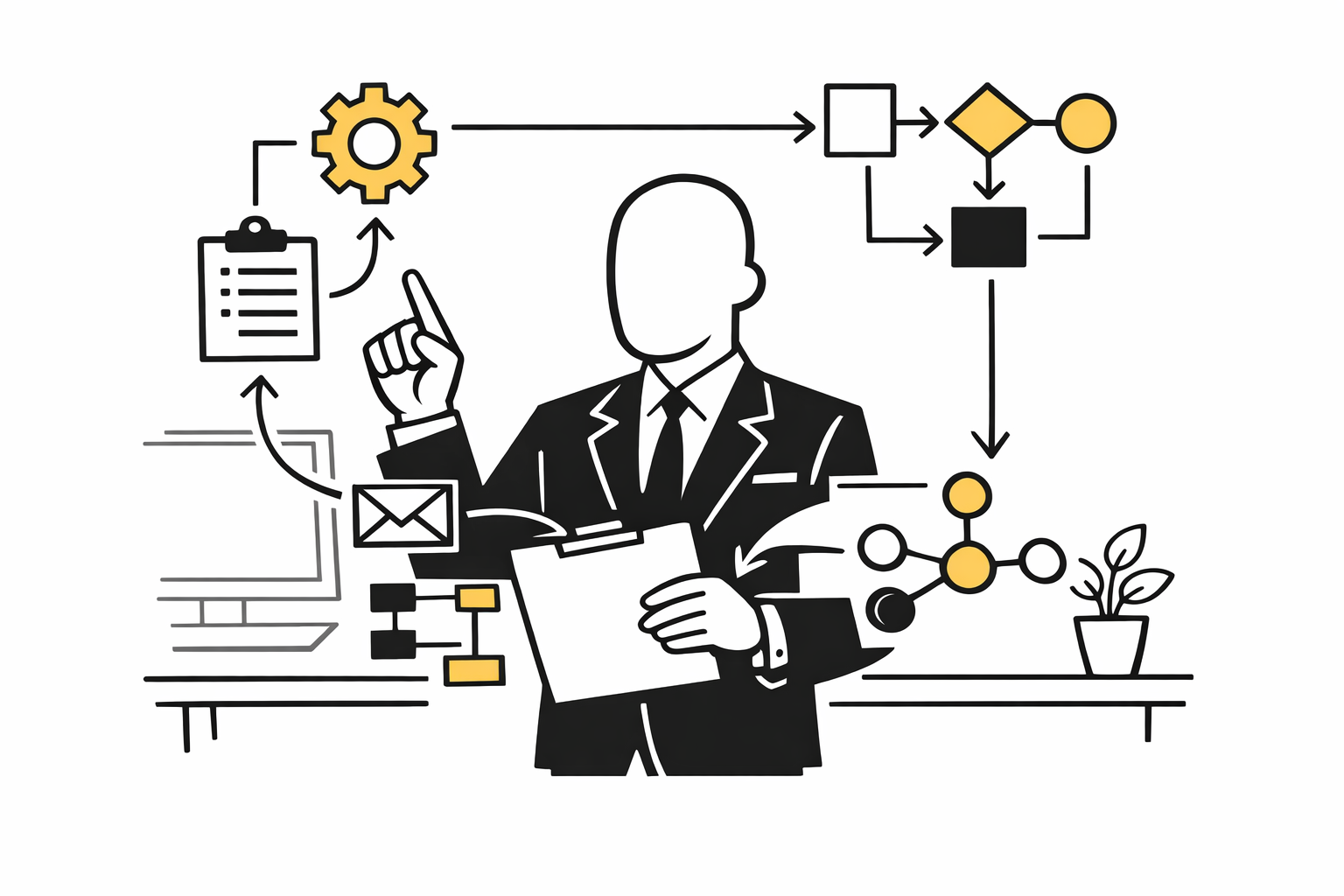
How Big Tech Automates Workflows: AI & Automation Guide
Automation is no longer just a buzzword - it's the driving force behind the efficiency and innovation fueling some of the world’s largest tech companies. From managing billions of search queries to responding to customer needs instantly, companies like Google, Apple, and Microsoft have turned automation into their competitive edge. But here’s the good news: these strategies aren’t exclusive to Big Tech. With the right tools and mindset, mid-sized professional service businesses can replicate and scale these automation practices to achieve similar results.
This article explores the transformative workflows employed by Big Tech, highlighting how you can adopt them to streamline operations, enhance efficiency, and unlock new growth opportunities.
The Secret Power of Automation in Big Tech
Why Automation is Essential
Automation is Big Tech’s superpower. It allows companies to handle massive-scale tasks with minimal manual intervention while focusing their energy on innovation. For instance:
- Google processes 8.5 billion searches daily and continuously updates its search index - all through automated systems.
- Apple automates its manufacturing processes and software updates, ensuring seamless product delivery and maintenance.
- Microsoft deploys cloud services, integrates customer support systems, and schedules updates without human interruption.
What makes automation so indispensable is its ability to minimize errors, boost efficiency, and scale operations effectively. For growing businesses, adopting similar strategies can reduce operational bottlenecks, save costs, and create room for innovation.
sbb-itb-f5716fb
Understanding Big Tech’s Automation Workflows
Automation in Big Tech revolves around a few cornerstone workflows that are both practical and repeatable. Here are the key areas making the biggest impact:
1. Data Processing and Integration
Big Tech companies have mastered the art of turning vast amounts of data into actionable insights.
- Google, for example, integrates data from multiple sources and transforms it for analytics with virtually no manual effort.
- For mid-sized businesses, tools like no-code automation platforms can replicate such workflows. Here’s how you can start:
- Step 1: Use APIs to extract data from your platforms (e.g., sales tools or CRMs).
- Step 2: Automate data cleaning for consistent formatting.
- Step 3: Push the processed data to dashboards for real-time decision-making.
With these steps, businesses can automate repetitive data tasks and free up time for strategic projects.
2. Software Deployment Pipelines
Tech giants like Microsoft leverage Continuous Integration and Continuous Deployment (CI/CD) pipelines to automate software updates and deployments.
- For businesses handling custom software or internal tools, automation can help reduce risks and speed up delivery.
- Example: Integrate GitHub Actions to automate code deployment, ensuring updates are seamless and reliable.
3. Customer Interaction Automation
Apple handles millions of customer interactions through automation, offering rapid and consistent support without overburdening human teams.
- For service businesses, creating a chatbot powered by AI tools like GPT can help:
- Respond to frequently asked questions.
- Handle support tickets automatically.
- Collect customer feedback effortlessly.
Supercharging Automation with AI
While automation handles repetitive tasks, Artificial Intelligence (AI) adds predictive capabilities and personalized insights. Big Tech companies combine AI with automation for transformative results:
- Google DeepMind optimizes energy consumption in data centers, saving millions annually.
- Apple’s Siri and Microsoft’s chatbots manage millions of interactions daily.
Here’s how mid-sized businesses can harness AI with automation:
- Sentiment Analysis: Use AI to analyze customer feedback and gauge satisfaction levels.
- Predictive Maintenance: Leverage AI to detect potential system failures before they occur.
- Automated Reporting: Generate summaries and actionable insights from raw data for your team.
The beauty of combining AI and automation is that it doesn’t require a billion-dollar budget. No-code platforms and pre-built AI tools make these capabilities accessible to businesses of all sizes.
Scaling Automation: Lessons from Big Tech
Scaling automation is where Big Tech truly shines, but it’s also achievable for smaller operations. Here are some strategies to apply:
1. Efficient API Management
- Microsoft processes millions of API requests daily using queueing systems to efficiently distribute load.
- Small businesses can replicate this by using wait nodes or batch processing to pace API requests and avoid hitting rate limits.
2. Smart Monitoring and Alerts
- Real-time monitoring ensures your workflows are running smoothly. Set up automated alerts to notify your team when errors or delays occur.
3. Cost Optimization
- Automate tasks that consume significant resources, such as data entry, social media scheduling, or customer support.
By building scalable workflows, businesses can handle growing demands without increasing operational costs.
Practical Automation Ideas for Your Business
To get started with automation, you don’t need to overhaul your entire operation. Here are three simple projects to inspire you:
-
Social Media Analytics Dashboard
- Automatically pull data from LinkedIn, Twitter, and Instagram.
- Consolidate insights into a single dashboard to track performance in real time.
-
AI-Powered Report Generation
- Use AI to summarize daily sales reports or project updates.
- Email actionable takeaways to key team members automatically.
-
Smart Alert Systems
- Monitor critical systems or APIs.
- Set up triggers for automatic alerts when anomalies are detected.
These projects demonstrate that automation doesn’t have to be complex to be impactful.
Key Takeaways
Here are the most important insights from Big Tech’s automation playbook:
- Automation is a competitive edge: It minimizes errors, boosts efficiency, and frees up resources for innovation.
- AI enhances automation: From sentiment analysis to predictive maintenance, AI adds intelligence to workflows.
- Start small but think big: Simple automation tasks - like report generation or data cleaning - can make a significant impact.
- Scale like Big Tech: Manage APIs efficiently, monitor workflows in real time, and optimize costs with automation tools.
- No coding skills required: With no-code platforms, anyone can build powerful automation workflows.
By adopting these practices, mid-sized businesses can work smarter, not harder, and position themselves for sustainable growth in a competitive market.
Conclusion
Big Tech’s success with automation isn’t just about having access to large resources - it’s about using clever, scalable strategies to simplify complex processes. The same principles can transform mid-sized service businesses into lean, efficient, and innovative operations. Whether it’s automating customer interactions, managing data, or deploying software, the possibilities are endless.
The future of business lies in automation - and with the tools available today, it’s a future that’s well within your reach. Start small, aim high, and watch as automation unlocks new levels of efficiency and success for your business.
Source: "How Big Tech (FAANG) Automate their Workflow" - Chinwe O., YouTube, Sep 27, 2025 - https://www.youtube.com/watch?v=XR0vU4HoG9g