
deploy AI agents fast
Deploying AI agents quickly is no longer a luxury - it’s a necessity for businesses aiming to stay competitive. Mid-sized companies, in particular, benefit from fast implementation, as it reduces costs and accelerates ROI. Starter Stack AI offers a solution that focuses on speed, integration with existing tools, and clear results. Here’s how it works:
- Focus on Immediate Impact: Identify and automate high-impact workflows like purchase orders or customer onboarding.
- No Overhauls Needed: Integrate AI with tools you already use (e.g., Salesforce, QuickBooks) without disrupting your current processes.
- Fast Results: Deploy production-ready AI agents in as little as 30 days.
- Transparent Monitoring: Use a dedicated client portal to track performance and progress in real time.
- Iterative Improvement: Start small, refine through feedback, and expand automation step by step.
Starter Stack AI ensures businesses can deploy AI agents quickly, see measurable outcomes, and scale automation without vendor lock-in.
Core Elements of Fast AI Agent Deployment
Setting Clear Objectives and Workflow Mapping
The first step to deploying AI agents quickly and effectively is setting clear objectives. Without well-defined goals, businesses risk creating solutions that don’t address their real challenges. To avoid this, start by pinpointing workflows that consume the most time and resources. These high-impact areas should be the primary focus for AI integration.
Mapping workflows accurately is just as important. This means documenting every step of the current process, including any manual fixes or workarounds employees rely on. The idea isn’t to fix broken processes before automating them. Instead, automate what already works and refine it later.
To see results quickly, target repetitive tasks with clear, structured workflows. Processes like purchase order management, invoice approvals, and customer onboarding are excellent candidates. These tasks often involve structured data and straightforward decision-making, making them ideal for AI automation. By starting here, businesses can achieve measurable results faster, build confidence in AI systems, and set the stage for broader adoption.
This phased approach also simplifies integration and reduces the risk of delays. Once objectives are clear, the next step is ensuring the data is ready for AI use.
Ensuring Data Readiness and Integration
When it comes to data, the goal isn’t perfection - it’s usability. Many businesses delay AI projects by trying to clean and organize all their data upfront, which can take months without delivering any immediate value.
Instead, focus on making data accessible and consistently formatted. Modern platforms like Salesforce, QuickBooks, and HubSpot already provide structured data that AI agents can use. The priority should be establishing reliable connections to these systems through APIs or other standard interfaces.
Successful integration doesn’t require overhauling existing systems. Instead, it’s about working with what’s already in place. APIs, webhooks, and standard data formats allow AI to integrate seamlessly into current workflows. The best AI implementations are nearly invisible to the end user - they simply enhance speed and reliability.
When planning integrations, think about how data flows between systems. AI agents need to access, process, and update information in real-time. Poorly designed data flows can create bottlenecks or disrupt existing processes. Once data connections are stable, the focus shifts to building scalable automation infrastructure.
Using Automation and Scalable Infrastructure
With workflows and data connections in place, the next step is to implement scalable automation that supports long-term growth. Infrastructure should be robust enough to handle real-world business volumes without requiring major upgrades as usage increases. Cloud-based solutions are often a smart choice since they offer scalability without significant upfront costs.
AI agents should be designed to operate independently, with built-in error handling, exception management, and fallback procedures to minimize manual intervention. This ensures smooth operation even when unexpected issues arise.
Monitoring and logging are essential for managing automated systems at scale. AI agents need to provide clear insights into their actions, decisions, and performance. This transparency helps businesses identify areas for improvement and resolve problems before they disrupt operations.
Scaling automation should be a gradual process. Start with a small subset of tasks or transactions, monitor performance closely, and then expand as confidence grows. This step-by-step approach allows teams to address potential issues early, ensuring that scaling doesn’t compromise critical operations.
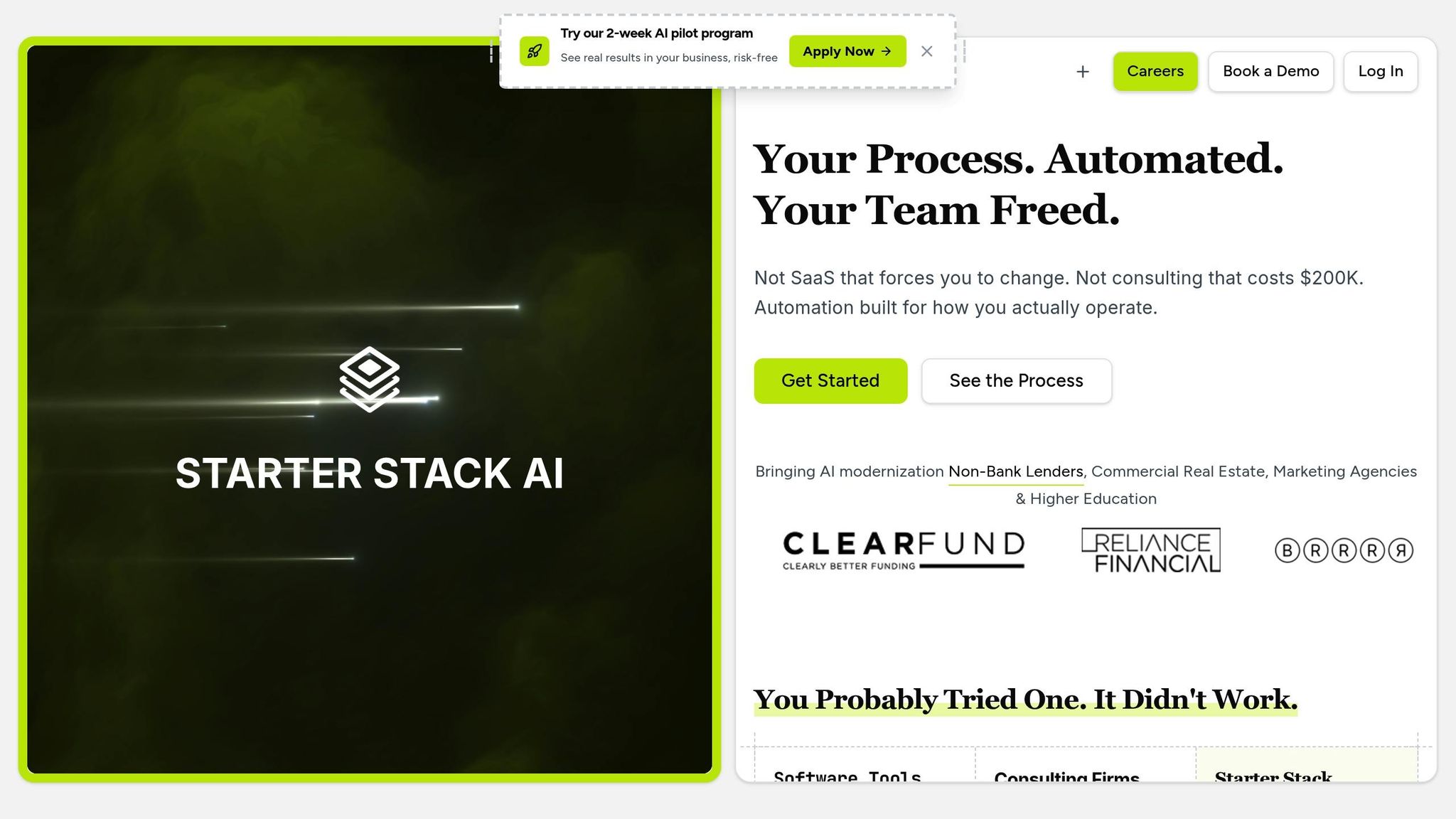
Step-by-Step Guide to Deploying AI Agents with Starter Stack AI
Identifying Workflows and Scoping Projects
The first step is to zero in on a critical bottleneck in your operations. Instead of overhauling your entire workflow, Starter Stack AI focuses on automating the single most pressing issue. This could be anything from delays in client intake that jeopardize deals, to high rework rates in underwriting that drain resources, or compliance backlogs that create regulatory risks.
Starter Stack AI’s experts work closely with your team to identify a high-impact problem. The key is selecting a process that’s both problematic and measurable - something where delays or errors have clear financial implications. Once the issue is pinpointed, the team maps out your current process exactly as it functions today, without requiring any immediate changes to your operations.
The goal is to identify human tasks that can be automated while keeping your existing workflows intact. As Tod Ellington, Chief Operating Officer at Whitestone Branding, puts it:
"Starter Stack AI is sort of like this hybrid approach between experts and AI, making it a little faster, but you still have expertise behind it. And you pay a flat fee. I'd rather do that than figure it out myself and have it go faster. Like, you know, MVP up in a week or two or three - that's music to my ears." [2]
This scoping phase is quick, often completed in just a few days. Clear deliverables and timelines are established from the outset, ensuring that development efforts are laser-focused on areas with the highest potential return on investment.
Integration and Iterative Development
Starter Stack AI is designed to work with your existing tools and systems. Whether you use Salesforce, QuickBooks, or custom APIs, the platform integrates seamlessly to enable smooth data flow.
For businesses with more specific needs, custom integrations are available through the Growth Plan ($9,000 per month). These integrations allow AI agents to connect directly with essential systems like loan origination systems (LOS) or customer relationship management (CRM) platforms, enabling real-time updates and data access.
You’ll see results quickly. An initial working system is typically deployed within 30 days, followed by weekly iterations. This means AI agents can start handling real tasks almost immediately.
Clients on the Foundation Plan ($5,000 per month) receive weekly system updates and improvements, while Growth Plan clients benefit from dedicated weekly AI consultations. This iterative process ensures that the AI agents are continuously refined through real-world use, becoming increasingly effective.
Once the initial workflow is validated, you can expand to additional processes using the same strategy. With each new deployment, the process becomes faster and more streamlined.
Tracking Progress Through the Client Portal
Progress tracking is an integral part of the Starter Stack AI experience. You’ll receive weekly updates and performance metrics that highlight tangible results, such as time saved and error reductions.
Foundation Plan clients can access asynchronous Slack support, while Growth Plan clients enjoy priority support and weekly AI consultations. These consultations provide an opportunity to review performance, discuss improvements, and explore new automation opportunities.
Weekly updates include clear documentation of system changes and improvements, ensuring transparency. Businesses can see exactly how their investment is being utilized and the results it’s delivering.
Starter Stack AI’s commitment doesn’t end with deployment. Unlike one-off consulting services, they maintain an ongoing partnership to continuously refine and improve the solutions. This approach ensures that AI agents not only adapt to new challenges but also scale effectively as your business grows.
Key Tools and Frameworks for Faster Deployment
Deployment Frameworks Supporting Quick Integration
Deploying AI quickly requires frameworks that streamline integration without compromising functionality. Modern deployment frameworks enable modular development, allowing individual components to be built, tested, and deployed independently - minimizing disruptions to existing systems.
Take LangChain, for instance. It's a go-to choice for creating AI applications that pull data from multiple sources and APIs. With its modular design, LangChain supports connectors for tools like Salesforce, Slack, and Google Workspace. This eliminates the need to build custom integrations from scratch, saving both time and effort.
Another example is Microsoft's Semantic Kernel, which is particularly useful for businesses already using Microsoft's ecosystem. It integrates seamlessly with .NET applications and Azure services, offering a programming model that combines natural language processing with traditional coding methods.
Then there’s AutoGen, a framework designed for managing multi-agent AI collaboration. It enables AI agents to work together on complex, multi-step workflows. For example, in a loan application process, one agent might handle credit checks, while others manage document verification and compliance review.
These frameworks come with standardized APIs, built-in error handling, and support for incremental deployment. This modularity ensures that initial implementations can evolve smoothly into more advanced systems without disrupting operations.
How Starter Stack AI Uses These Tools
Starter Stack AI leverages these frameworks to deploy AI solutions in a matter of days. The process starts with rapid prototyping, followed by iterative refinement, taking full advantage of the modular features these tools offer.
When a client identifies a bottleneck in their workflow, Starter Stack AI selects the framework that best aligns with the client’s existing tech stack. Thanks to a flat-rate subscription model, the platform minimizes the need for custom development. Instead of building integration layers from scratch, Starter Stack AI configures pre-existing framework components to fit the client’s specific needs - significantly cutting down on development time.
By combining tools like LangChain, Semantic Kernel, and AutoGen, Starter Stack AI creates hybrid solutions tailored to the unique requirements of each workflow. These tools work together seamlessly, ensuring sophisticated orchestration while maintaining system stability.
To enhance transparency, the client portal provides real-time insights into active agents, processing volumes, and integration health. This visibility not only builds trust in the AI systems but also reinforces the value of the investment.
Crucially, Starter Stack AI ensures that clients retain 100% ownership of their code and intellectual property. When businesses are ready to scale or bring development in-house, they have full access to their AI systems - free from vendor lock-in. This guarantees a smooth transition for future growth and scalability.
sbb-itb-f5716fb
Ensuring Reliability and Accountability in AI Deployment
Testing and Validating AI Agents
To ensure AI agents perform as expected in live environments, rigorous testing is a must. Especially when deploying quickly, a robust testing framework helps catch potential issues before they disrupt operations. The key is to embed validation into every step of the development process, rather than treating it as a last-minute task.
One critical area is error handling. Systems should be designed to manage unexpected inputs, API failures, or data inconsistencies by rerouting failed tasks to human reviewers or alternative workflows. This kind of fallback mechanism ensures that a single error doesn’t derail an entire process.
Real-time monitoring is another vital component. By tracking metrics like processing volumes, response times, and error rates, teams can identify anomalies - such as unusually slow processing or unexpected error spikes - and investigate them immediately.
Simulated load testing under peak conditions is also essential. This type of stress testing uncovers bottlenecks and ensures the AI can handle high-demand scenarios without faltering.
Finally, data validation should be built into integrations, ensuring the integrity of information as it moves between platforms like Salesforce, QuickBooks, or custom databases. This keeps processes running smoothly and prevents data-related errors.
Starter Stack AI's Client Portal for Full Transparency
Starter Stack AI offers a client portal that provides complete visibility into AI operations through a dedicated dashboard.
This portal allows clients to monitor agent activity, track milestones, and review performance metrics in real time. It also serves as a communication hub, enabling direct interaction with the development team.
Performance metrics in the portal give clients actionable insights into the AI's effectiveness. Key indicators, such as processing accuracy, time savings, and workflow completion rates, clearly demonstrate the business impact of the deployment. These insights not only quantify results but also highlight areas where further improvements can be made.
Additionally, the portal organizes all project-related files and documentation. Clients can easily access and download code, review technical specifications, and retrieve integration guides. This ensures full ownership of intellectual property and simplifies any future scaling or modification efforts.
Continuous Improvement Through Feedback Loops
AI systems thrive on continuous improvement, which is driven by systematic feedback and regular updates. This iterative approach allows initial deployments to grow into more advanced systems that adapt to evolving business needs.
User feedback plays a crucial role here. Frontline users interacting with the AI daily often spot edge cases, inefficiencies, or new automation opportunities that might not have been evident during development. Incorporating their input helps refine the system.
Performance data analysis is another cornerstone of this process. By examining logs, error rates, and task completion times, developers can identify problem areas and implement targeted enhancements.
A/B testing is also a valuable tool, allowing teams to compare different agent configurations under real-world conditions to determine which setup performs best.
Regular review cycles ensure that AI agents stay aligned with business needs. As companies grow and processes evolve, these review schedules - tailored to the complexity of the deployment - ensure timely updates that maintain the AI’s effectiveness.
The feedback loop extends to integration health as well. Continuous monitoring of third-party systems catches any issues caused by API updates or data format changes, triggering quick adjustments to avoid disruptions.
"We shipped more in 2 weeks than our old dev team did in 2 quarters." – Finance COO, Starter Stack client
This combination of accountability, transparent monitoring, and systematic feedback creates AI deployments that deliver long-term value. Starter Stack AI’s approach ensures that its systems not only meet current needs but also evolve to meet future challenges, all while maintaining a fast and reliable deployment process.
Conclusion: Achieving Business Growth Through Fast AI Deployment
Key Takeaways for Businesses
Looking back at the strategies discussed, a few critical points stand out for leveraging AI to drive business growth. Fast deployment doesn’t just deliver quick wins - it also sets the stage for scalable, dependable, and efficient operations.
The most effective AI implementations start by tackling one specific operational challenge. Once that issue is addressed, businesses can gradually expand AI applications to other workflows, building on the same foundation. This step-by-step method minimizes risks and builds trust in the system’s capabilities.
Transparency is equally important. Businesses need clear insights into how AI agents operate and perform. Without this, scaling or improving AI systems becomes a guessing game. Tools like real-time monitoring, performance metrics, and access to development teams are essential for making informed decisions and ensuring long-term success.
Another critical factor is seamless integration. AI solutions should complement and enhance existing workflows rather than replace them. This approach retains valuable institutional knowledge while introducing automation for efficiency.
Starter Stack AI: A Solution Built for Business Growth
Starter Stack AI is designed to address the specific challenges mid-sized businesses face when adopting AI. By combining expert guidance with advanced AI automation, the platform ensures deployments are both fast and dependable. This means businesses can achieve enterprise-level results without needing an in-house AI team.
The platform’s iterative deployment strategy is particularly advantageous for growing businesses. For example, Starter Stack AI can automate a single workflow in just 30 days. From there, companies can expand to other areas such as underwriting, compliance, reporting, or monitoring - all using the same proven framework. Each new deployment becomes quicker and more efficient as the foundation strengthens [1].
What sets Starter Stack AI apart is its dedication to continuous improvement. Weekly system updates and ongoing collaboration ensure that AI agents stay aligned with evolving business needs. This transforms AI adoption from a one-time project into an ongoing growth partnership.
For businesses looking to implement AI without the complexity of building internal expertise, Starter Stack AI offers a straightforward solution. Its combination of rapid deployment, transparent operations, and scalable design provides a clear path to sustained growth. By turning fast implementation into a competitive advantage, Starter Stack AI helps businesses thrive in an increasingly automated world.
Deploy AI Agents in Minutes: Step-by-Step Guide with Free Template
FAQs
How can mid-sized businesses prepare their data for rapid AI deployment without spending too much time on cleaning?
To get your data ready for AI deployment without spending too much time on cleaning, focus on methods that simplify the process while keeping the data functional. Begin by creating a knowledge layer - this organizes your structured data and improves how unstructured data can be searched. It gives AI agents a solid base to operate efficiently.
You might also consider using data masking or synthetic data generation. These techniques allow you to build realistic datasets for development while staying compliant with privacy laws. On top of that, set up observability for your AI systems. By adding reasoning traceability, you can monitor decision-making steps, tool usage, and confidence levels. This ensures your systems remain transparent and dependable.
What advantages does Starter Stack AI offer to businesses new to AI automation?
Starter Stack AI offers businesses a quick and straightforward way to bring AI automation into their operations, even if they’re just starting out with the technology. With its easy-to-use frameworks and deployment tools, it cuts down on development time while delivering solutions that are ready for real-world use.
Here’s what makes it stand out:
- Fast deployment: Launch AI agents quickly without needing deep technical expertise, saving both time and effort.
- Flexible scaling: Adjust and expand AI solutions seamlessly as your business grows.
- Actionable insights: Gain access to strategies and case studies designed to address actual business challenges.
By simplifying the integration process, Starter Stack AI empowers businesses to leverage AI effectively and stay ahead in today’s competitive landscape.
How does Starter Stack AI ensure transparency and accountability in AI deployments, and why is this crucial for businesses?
Starter Stack AI places a strong emphasis on transparency and accountability by integrating clear documentation, reliable monitoring tools, and ethical AI practices into every step of the deployment process. This approach allows businesses to closely monitor AI decision-making, spot potential biases, and maintain trust with their stakeholders.
For companies, these efforts are crucial. They help build confidence in AI systems, ensure compliance with regulations, and reduce potential risks. By prioritizing transparency, businesses can improve their operations, safeguard their reputation, and provide outcomes that are both fair and dependable.